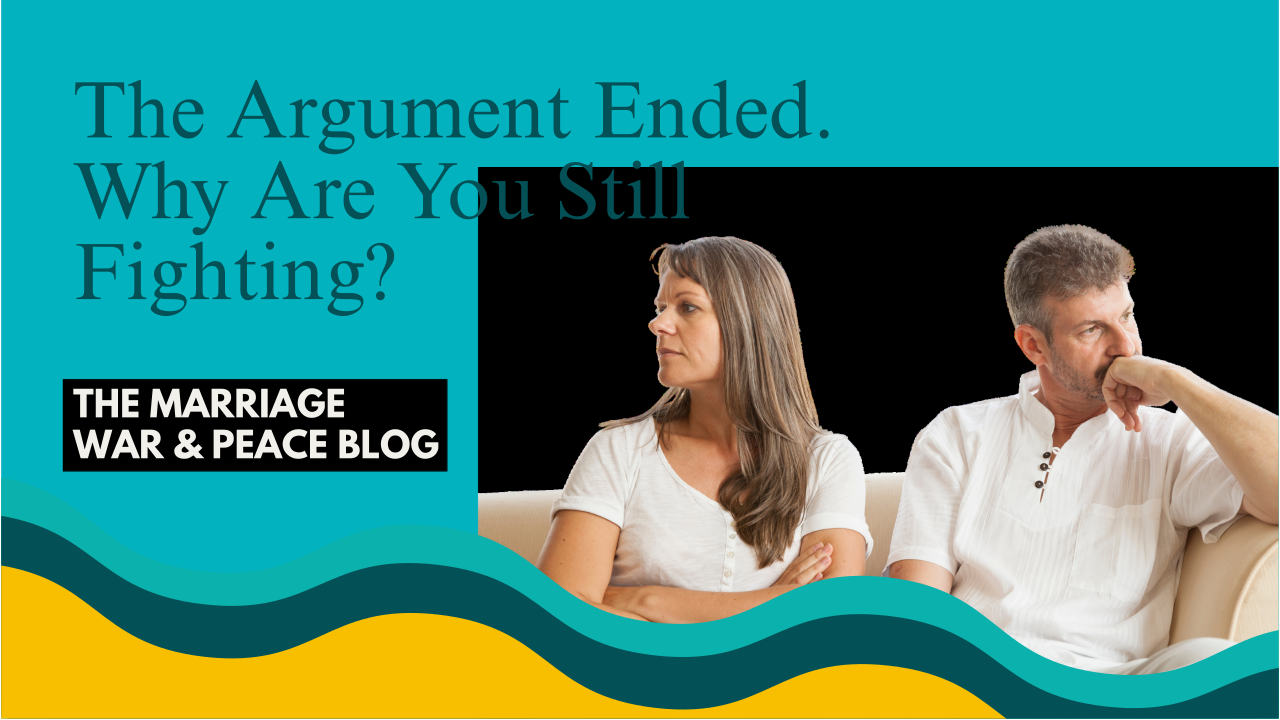
The Argument Ended. Why Are You Still Fighting?
Welcome to our Marriage War and Peace blog for August!
With Veronica L. Nabizadeh
Some arguments last fifteen minutes. Others last three days.
Not because anyone is still talking or doors are still slamming. But because the conversation never really ended!
Long after the words have stopped, the argument continues inside your mind. You replay what was said. You imagine what you wish you'd said. You build your case. You relive the hurt. And without realizing it, you carry yesterday's conflict into today's relationship.
That's what we're exploring in this month's issue of The Marriage War and Peace Blog—the invisible emotional residue that lingers after an argument and quietly steals connection, peace, and intimacy.

Each month, I share practical relationship tools, honest conversations, and encouraging insights to help you strengthen your marriage, reconnect with yourself, and create greater peace, understanding, and hope in your relationship. My desire is to remind you that if it's worth fighting about, it's worth fixing.
If you're not already subscribed, I invite you to join our community. You'll receive The Marriage War and Peace Blog, exclusive relationship resources, and updates about upcoming webinars, events, and new tools designed to help you build a stronger, healthier marriage.

By the time most couples stop arguing, something else has already begun.
The conversation has ended, but the replay has just started.
It follows you into the grocery store.
It rides beside you on your drive to work.
It whispers while you're folding laundry or trying to fall asleep.

You think of the perfect comeback—hours too late.
You wonder why your spouse couldn't see what was so obvious to you.
Before long, you’re no longer responding to the conversation that originally happened. You're responding to the version that's been playing on repeat inside your mind.
Your shoulders tighten. Your breathing becomes shallow. Your heart begins to race. Although nothing new is happening, your nervous system responds as if the fight has just begun.

I've seen this pattern in hundreds of women I've coached. More importantly, I've lived it.
One of the greatest misconceptions about marriage is that conflict is what damages a relationship.
It isn't.
Conflict is inevitable. Put two people together—each with their own history, fears, communication style, and expectations—and disagreement is unavoidable.
The greater damage is what happens afterward.
That's why this month's Marriage Question of the Month matters so much.
Marriage Question of the Month

Have you ever found yourself thinking: Didn't we already settle this?
Maybe the words are different.
Maybe the situation has changed.
Maybe weeks—or even months—have passed.
Yet somehow, you find yourselves standing on the same emotional battlefield, fighting what feels like the very same fight.
If that sounds familiar, here's the truth:

Most couples believe recurring conflict is caused by poor communication. While communication certainly matters, it isn't usually the root problem. More often, communication simply reveals something deeper that has never fully healed.
Think of conflict like an iceberg. The words you exchange—about money, intimacy, parenting, household chores, or in-laws—are the part floating above the surface. Beneath the waterline are the emotions driving the conversation: feeling unappreciated, rejected, dismissed, controlled, unseen, unsafe, or even not chosen.
Until those deeper feelings are acknowledged, the argument may end, but the hurt doesn't.
I often tell my clients, "The first fight is usually about the issue. Every fight after that is about the emotional residue the first one left behind."

Imagine a wife who asks her husband to help more around the house. He hears criticism. She experiences indifference. They argue, apologize, and move on—or so they think.
A week later, he forgets to take out the trash.
Objectively, it's a small oversight.
Emotionally, it confirms the story she's already telling herself: I'm carrying this marriage alone.
He, meanwhile, hears another reminder and thinks, Nothing I do is ever enough.
Neither of them is responding only to the trash—they're responding to the meaning they've attached to it.
That's why the same fight keeps returning. Not because the problem was never discussed, but because the pain underneath it was never fully understood.
One of the most powerful shifts you can make is learning to separate what happened from the story you're telling yourself about what happened.

Stories feel true because they're woven from our past experiences, disappointments, wounds, and fears. They shape the meaning we assign to what happens—but they aren't always an accurate reflection of reality. When we respond to the story we've created rather than to our spouse's actual words or actions, we end up arguing with assumptions instead of engaging with the truth.
That doesn't mean your feelings aren't real. They absolutely are. Your emotions deserve to be acknowledged and honored. But feelings are invitations to become curious, not proof that your interpretation is correct. They point us inward, asking, What is this experience trying to teach me? What old wound or unmet need is being stirred?
This kind of self-reflection is where marriage begins to move beyond a relationship and becomes a spiritual practice. Every disagreement becomes an invitation to know yourself more deeply, to heal what has been hidden, and to choose love over reactivity. Instead of asking, How do I change my spouse? you begin asking, What is this moment asking me to learn?
The healthiest couples I've worked with don't avoid conflict. They approach it with curiosity. They understand that every disagreement offers an opportunity to discover something new about themselves, their partner, and the relationship they're creating together. When curiosity replaces certainty, defensiveness begins to soften, compassion enters the conversation, and healing becomes possible.
So, the next time you find yourself thinking, here we go again, pause before assuming you're back at the beginning.
You may be standing at the doorway of an old hurt that's quietly asking to be healed.
Every replay strengthens the wound.
Every moment of curiosity begins to heal it.
From The Battle-Weary Wife’s Deck of Strength and Wisdom

Affirmation: I choose peace over proving my point. Peace is more powerful than proving my point.
One of the reasons arguments linger long after they've ended is that we keep trying to prove our case. We replay the conversation, gather evidence, and mentally rehearse the next
round—hoping that if our spouse finally understands our perspective, we'll finally find peace.
But peace doesn't come from winning the argument—it comes from understanding what the argument is really asking of us.
Every time you replay a disagreement, ask yourself: “Am I trying to prove my point or connect with my heart?”
Those are very different goals.
When your priority shifts from being right to being understood—and from proving your spouse wrong to seeking genuine connection—you create space for healing instead of more hurt.
Choosing peace over proof doesn't mean your feelings don't matter or that you ignore real problems. It means you refuse to let the need to win become more important than the relationship you're trying to strengthen.
Sometimes the strongest person in the marriage isn't the one with the best argument. It's the one courageous enough to choose connection first.
THIS MONTH’S PEACE PRACTICE
Five-Minute Peace Practice
Put Down the Fight
The next time you notice yourself replaying an argument, give yourself five intentional minutes before you respond, send a text, or reopen the conversation.
Minute 1: Name What Happened
Separate the facts from the story.
Ask yourself:
What actually happened?
What assumptions have I added?
Keep your answer simple and factual.
Minute 2: Notice Your Body
Where are you holding the argument?
Is your jaw tight?
Are your shoulders tense?
Is your breathing shallow?
Take three slow, deep breaths and intentionally relax the area holding the tension.
Minute 3: Identify the Hurt
Anger is often the messenger, not the message.
Ask yourself: What am I really feeling beneath the frustration?
Perhaps it's disappointment.
Loneliness.
Feeling unheard.
Feeling unimportant.
Naming the deeper emotion often reduces its intensity.
Minute 4: Choose Your Next Step
Before you return to the conversation, ask: What response is most likely to build connection instead of creating more distance?
Minute 5: Release What Doesn't Belong to You
Close your eyes and take one final breath.
Remind yourself:
I don't have to carry this fight all day.
I can honor my feelings without letting them control my actions.
Peace begins with the choices I make next.
Then go do something that reconnects you with yourself—a short walk, a cup of tea, a prayer, a few quiet moments outside, or simply sitting in silence.
Because the goal isn't to win the next conversation.
It's to become the person who no longer has to.
Marriage tip: Every disagreement eventually ends. The choice is whether you'll keep carrying it or begin creating something better.
THIS MONTH’S RUNE PULL
This Month's Rune
From The Healing Runes for the Battle-Weary Wife

What am I assuming right now?
Many marriages are damaged by the story we immediately create afterward—not what was actually said.
Before replaying another argument, ask yourself:"What am I assuming that I haven't actually confirmed?"
Sometimes that one question changes everything.
THIS MONTH’S PROMOTION

Ready to Stop Carrying the Fight?
If today's article made you realize you've been carrying yesterday's argument into today, I want you to know something:
You don't have to keep living this way.
Imagine recognizing the moment conflict begins to take over—not hours later, not the next morning, but while it's happening. Imagine having a practical tool that helps you calm your emotions, interrupt the cycle, and respond in a way that protects both your peace and your marriage.
That's exactly why I created Stop, Drop, and Roll, Baby!®
On Thursday, August 27, at Noon EST, I'm hosting a FREE live webinar where I'll teach the same relationship tool that transformed my own marriage and has helped countless wives and couples break free from destructive conflict patterns.
During this practical and encouraging session, you'll discover how to:
Recognize the moment conflict begins to spiral.
Calm your emotions before they control your response.
Break the cycle of repeating the same arguments.
Respond in ways that invite connection instead of creating more distance.
Walk away with a simple tool you can begin using that very day.
If you've ever caught yourself saying, “Why do we keep having the same fight?” this webinar was created for you.
You don't have to keep replaying old arguments or carrying emotional residue from one day into the next. There is another way.
Imagine what your marriage could feel like a month from now if you stopped carrying yesterday's fight into tomorrow.

I hope you’ll join me.
Because if it’s worth fighting about, it’s worth fixing.